

Axolotl Axo A3

SoftwareAXO SUITE
Layer resolution<10 µm
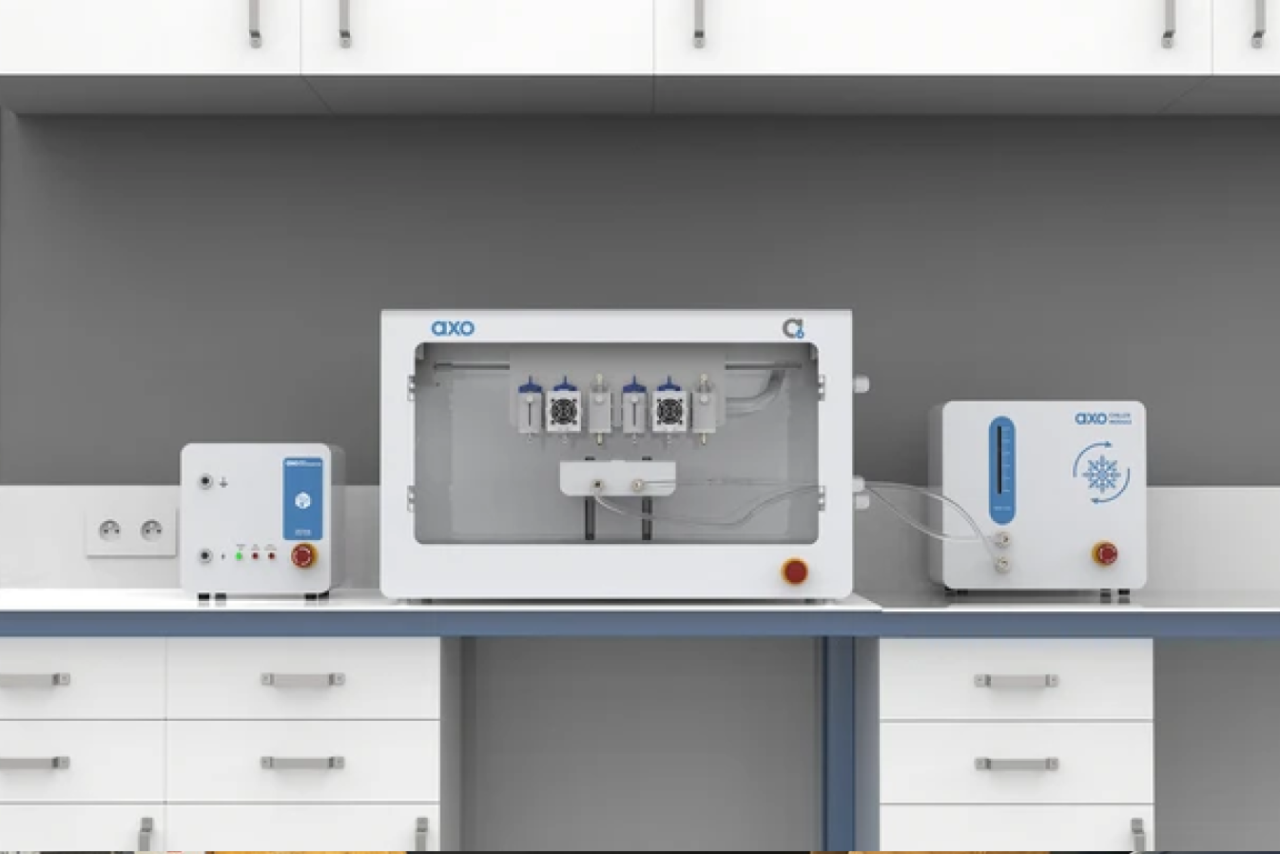
Special featureMelt Electrospinning and Melt Electrowriting Module
Printer heads3
Build chamber size130 x 90 x 100 mm
Air pressure range0 kPA – 800 kPA
Minimum build plate temperature-10°C


We have noticed that often students and postgraduates pursuing projects in biomaterials, bioprinting, tissue engineering need advanced equipment to carry out research. Bioprinting will also find use among hydrogel specialists, in instrumentation laboratories dealing with the characterization of microstructures and properties of biological materials, and in interdisciplinary research units working with medicine, pharmaceuticals or biotechnology.
The Axo A6 bioprinter will work well in medicine and biotechnology, material engineering, pharmacy, chemical engineering departments at technical and research universities.
Axo A6 is used by industries such as education and medicine.


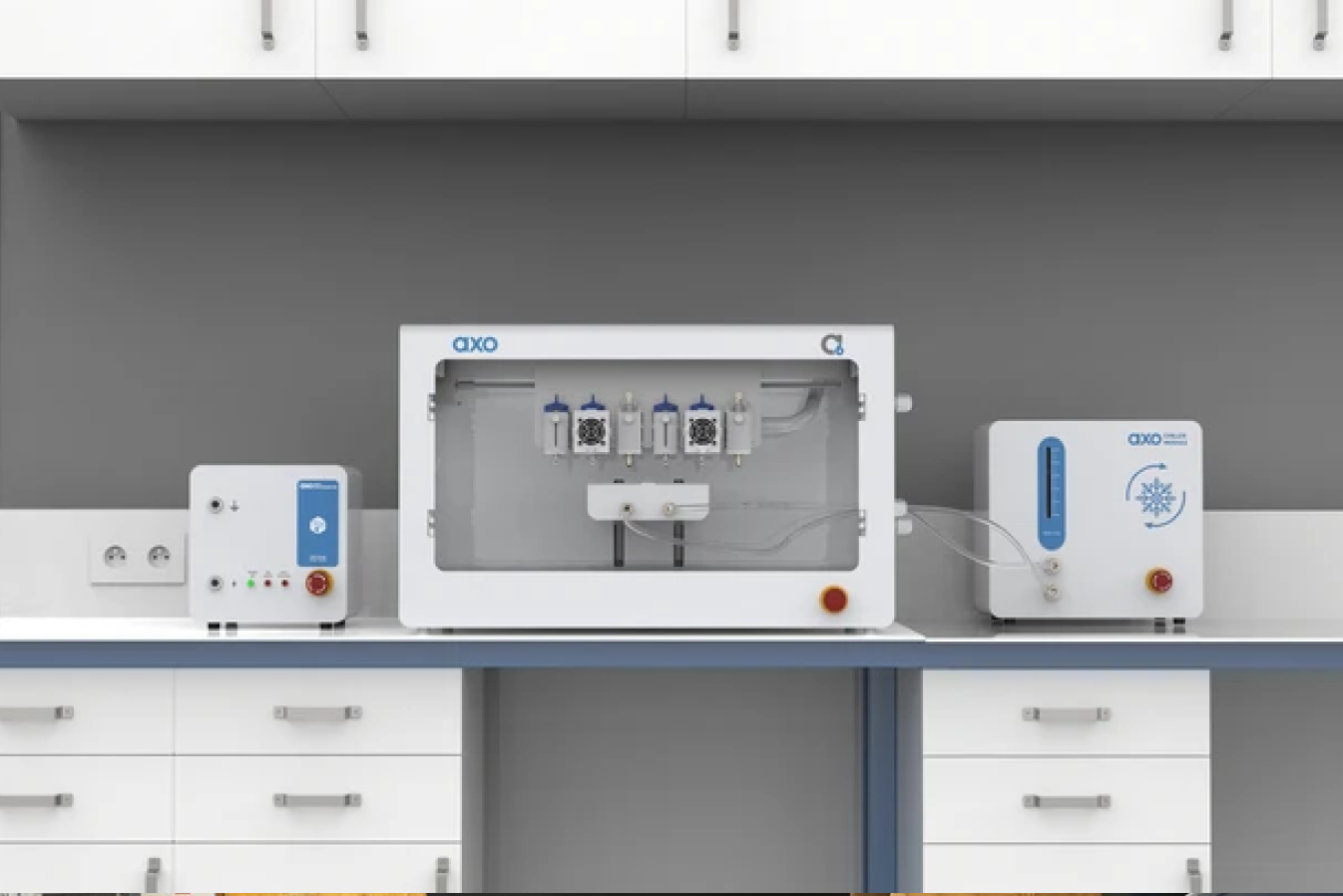
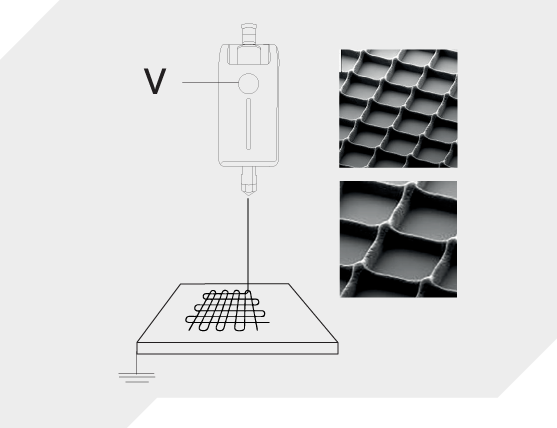
Melt Electrowriting (MEW) is a technology used by Axolotl Biosystems to create precise 3D fiber structures. In the process, molten polymer is formed into very thin fibers using an electric field and laid out layer by layer according to the designed geometry.
This makes it possible to produce ordered scaffolds with controlled porosity and shape, which are particularly useful in tissue engineering. MEW can be combined with 3D bioprinting to create more complex, multi-scale structures.
Electrospinning is a method of producing thin fibers from polymers using an electric field. The fibers are formed continuously and deposited randomly to form dense fibrous mats.
The technique is often used for membranes, coatings and scaffolds where high surface area and porosity are important, while it does not provide precise control over the placement of individual fibers.
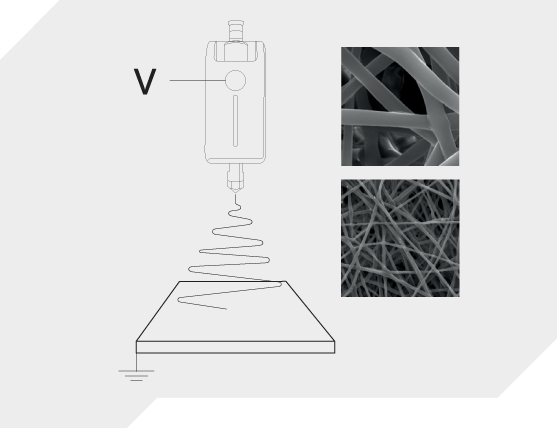
Electrowriting is a development of electrospinning, in which it is possible to control the trajectory of fiber deposition. Instead of random mats, the fibers are “written” in a planned manner, allowing the creation of ordered spatial structures.
One variation of this technology is precisely Melt Electrowriting (MEW), where molten polymers are used. By combining an electric field and the precise movement of the printing system, it is possible to create three-dimensional scaffolds with well-defined architecture.
| Melt Electrowriting Technology Pneumatically Controlled Extrusion | High voltage range (MEW) 0 kV – 15 kV DC |
| Current range (MEW) 0 µA – 150 µA | Print speed (MEW) < 50 mm/sec. |
| Air pressure range 0 kPa – 800 kPa | Print pressure resolution 0.1 psi |
| XY resolution per microstep 1 µm | Z resolution per microstep 1 µm |
| Layer resolution < 10 µm | Head temperature range room temperature (RT) – 265°C |
| HD head camera image resolution up to 1920 × 1080 pixels | Flat plate collector available |
| Rotary collector available | Collector speed range < 5000 rpm. |
Melt Electrowriting (MEW) – a precision polymer microfiber fabrication technique. Allows the creation of hybrid, multiscale tissue scaffolds.
Customizable printer and specific features
Large range of materials handled – biotechs, hydrogels, polymer materials
High precision and print resolution – 1 micron
Wide range of printheads – from pnematic to heated and cooled, UV and HD Camera
Intuitive and easy-to-use AXO SUITE software
Built-in UV-C sterilization
Automatic head calibration for table height and parallelism
Real-time control system for pressure and temperature parameters
Core Shell module – printing from two materials simultaneously
Rotary collector for printing cylindrical scaffolds
Ability to work on various substrates – Petri dishes, Multiwell plates, Insulated PE plate
The operating temperature range of the heads is from 3° C for cooled heads to 265° C for high-temperature heads. The work table, equipped with a standard cooling system, offers an operating range of 3 to 65° C.
However, it is possible to use additional water cooling allowing to lower the table temperature even to -10° C.
The very high resolution of the intensity control, in turn, allows precise dosing of material even with very low viscosity.
The rotary manifold enables printing of cylindrical scaffolds, particularly important in either blood vessel or airway projects.
The Core Shell module makes it possible to print two materials simultaneously, such as a softer hydrogel with a harder shell. This gives great possibilities when creating complex structures or testing drugs or substance interactions.
Intuitive and easy-to-use AXO SUITE software , which generates post-printing protocols for saving and replaying print settings. This means full control + easy repetition of experiments under the same conditions.
Yes, we won’t leave you alone. Along with each printer, we offer training for employees on how to use the device.
What will you gain by implementing Axo A6 in your institution?
Electrospinning makes it possible to produce fibrous structures from polymers by using electrohydrodynamic phenomena, leading to the formation of dense, randomly arranged fibrous mats. Based on the same physical principles, Melt Electrowriting (MEW) technology was developed, which, through precise control of the deposition process, allows the stacking of microfibers from thermoplastic polymers into engineered, three-dimensional architectures. This approach enables the creation of ordered tissue scaffolds compatible with 3D bioprinting for tissue engineering applications.
Do you want to get into 3D printing at the research level and need funding for selected solutions? Don’t want to lock up full amounts of your own funds? At CadXpert, we support you from the beginning of your journey and enable you to take advantage of leasing our equipment.


We work with several partners in obtaining financing for your projects. We will show you where you can go for support and get funding with simplified procedures and maximum customer care. We will help you buy and implement very quickly.

Leasing is the optimal solution for businesses. With no one-time investment, the device works for you from the beginning and you can treat the installments as a tax-deductible expense.
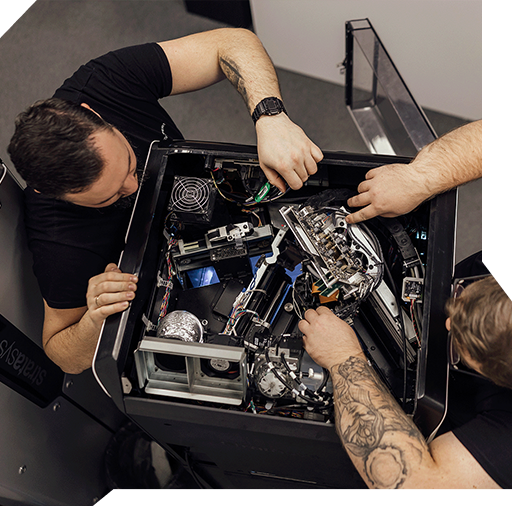
At CadXpert, certified engineers provide warranty care for equipment throughout its lifetime. There is no need to use foreign, non-responsive service centers.

You will be able to get in touch at any time about the operation of the device and get the missing information.
Our implementation consultants, as part of the initial application audit, will help you find additional applications for your printer so that you can realize the full potential of the device.
No – Axo A6 is a modular system that can be configured as both a basic research platform and an advanced tool for complex bioprinting experiments. Users can expand the system as their research needs grow.
Download the detailed technical specifications of the Axo A6 printer.
Many types of materials are available for the Axo A6 printer. Here are some examples:

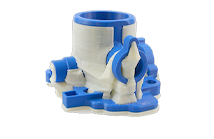
For a complete list of materials available for the Axo A6 printer, see the information document.
Yes, the Axo A3 is designed as a “lab in one machine,” supporting soft tissue bioprinting, bone, scaffolding, Melt Electrowriting and multi-material printing. This eliminates the need to purchase several separate systems.
AxoSuite software and updates are included free of charge with the printer.
We present a short video of the bioprinter at work. Melt Electrowriting.
We will start with a thorough understanding of your problem related to your research needs.
We will select the right bioprinting solutions, materials and offer the right printer.
If you accept all the components of the offer, we will proceed with the order.
We will arrange for the installation of the printer at your site and provide training to your employees on the operation of the device.
Your project will be the responsibility of one specific person who will be available to you at every stage of implementation.
If you are considering using 3D bioprinting and want to learn more, talk to our consultant.
As part of the conversation, the consultant:
In furtherance of our cooperation:
Do you have a specific problem or challenge that 3D printing could solve?
What size parts do you want to print?
Is the printout supposed to meet any additional requirements?


If you prefer a direct form of communication, below you will find
our phone and email contact.
Implementations: +48 577 127 775
Ordering materials: +48 733 501 666
3D printing services: +48 666 682 400
info@druk3d.cx
zamowienia@druk3d.cx
uslugi@druk3d.cx
Still wondering? We hope this list of frequently asked questions will help answer some of your doubts.
Axolotl A6 is a multi-purpose modular bioprinting system with six independent head slots, enabling multi-phase printing in a single process. It provides high precision and material flexibility.
The system supports up to six printheads simultaneously, with independent temperature and parameter control for each.
The Axo A6 supports air biodeprinting, core-shell biodeprinting, Melt Electrowriting and Melt Electrospinning. This makes it suitable for a wide range of research applications.
Yes, the workbench can operate at temperatures as low as -10°C, and dedicated cooling heads enable printing of thermally sensitive materials.
The system achieves an XY and Z axis resolution of 1 µm and a layer thickness of less than 10 µm. This makes it possible to create highly detailed 3D structures.
The bioprinter is controlled by dedicated AxoSuite software, designed specifically for bioprinting, with support for multiple print heads and protocols.
Yes, the system has built-in HEPA filters and solutions to enhance user safety and protect materials from contamination.
The main difference is the number of simultaneously supported print heads, 3 and 6 respectively. There is also a slight difference in the size of the work area.