Explore the range of educational and hobbyist 3D scanners
Educational and hobby 3D scanners are devices that allow you to transfer real objects into the digital world with extreme accuracy. They are ideal tools for schoolchildren, students, designers, artists and all enthusiasts who want to make their ideas a reality. With ease of use and intuitive software, you can easily create digital models for 3D printing, virtual reality (VR), design or archiving. Our portfolio includes a wide range of 3D scanners to help you turn inspiration into a finished project.
Educational vs. hobby 3D scanners – which to choose?
Although both categories serve similar purposes, important differences will help you make the right choice.
- 3D educational scanners: designed for ease of use, safety and affordability. They are an excellent choice for schools, universities and novice users. They enable interactive lessons and introduce students to the world of 3D technology.
- Hobby 3D scanners: offer higher precision, speed and more advanced features such as texture and color scanning. This is equipment for more demanding artists, modelers or designers who expect high quality detail in their digital models.
What to look for when choosing a 3D scanner?
Choosing the ideal device depends on the specifics of your projects. Pay attention to the following parameters to make sure the scanner meets all your expectations.
- Accuracy (precision): this is an important parameter that determines how faithfully the scanner will reproduce details. For simple projects, an accuracy of 0.1 mm is sufficient, but for scanning small, complex objects, it is worth choosing a model with a precision of 0.05 mm or higher.
- Scanning speed: determines how much data the device is able to collect per second. A higher speed significantly reduces working time, especially when digitizing large areas.
- Scanning technology: the segment’s most popular structured light technology is safe for the eyes and is perfect for digitizing objects indoors.
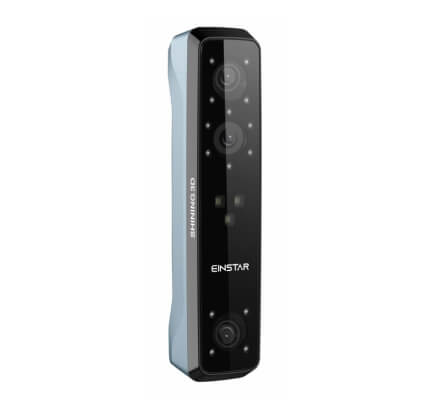
- Mobility: handheld, wireless scanners such as EinStar give you complete freedom of work and allow you to scan objects outside the office or studio.
Applications of hobby and educational 3D scanners
The possibilities for using 3D scanners are virtually endless. We have collected some popular examples below.
- Education and science: creating interactive teaching aids, digitizing biological or historical exhibits.
- Modeling and 3D printing: copying and scaling existing objects, recreating damaged or inaccessible parts.
- Culture and art: digital archiving of artworks, sculptures and monuments, creation of virtual museums.
- Design and VR/AR: transferring real characters and objects into the world of computer games and virtual reality applications.
Hobby versus professional scanners – significant differences
Wondering if you need a more advanced solution? Educational and hobbyist scanners are ideal for learning and creative projects. However, if your tasks involve precision quality control, top-level reverse engineering or metrology measurements, you should consider industrial 3D scanners that provide the highest accuracy.
Frequently asked questions about educational and hobby scanners
- How much does a good 3D scanner cost for a hobbyist? Prices for basic models start at a few thousand zlotys. Proven and versatile devices, such as EinStar, cost around £5,000, offering excellent quality in this price class.
- Are 3D scanners difficult to use? Most of the models we offer are designed with ease of use in mind. Intuitive software guides the user step by step. In addition, we offer professional training on how to use the purchased equipment.
- What can I use the scanned 3D model for? You can immediately send the model in STL or OBJ format for 3D printing, use it in computer graphics programs or, after further processing, use it in professional CAD software for further design.
Have doubts and don’t know which 3D scanner will be suitable for your project? Contact our experts, who will be happy to answer all your questions and help you match the device.